Click This Article If You're Stupid
Go on. Click it.

Did you click on this?
Seriously? Why’d you click on this?
C’mon, you gotta have a little more faith in yourself! You aren’t stupid and I’ll prove it.
Before we go on: is this title considered clickbait? Kinda right? Honestly, I thought it would be more like anti-clickbait.
I want to talk about intelligence, or more specifically, what it actually means to be intelligent. This sounds simple, but there are many different approaches taken in the world of psychology.
What is Intelligence?
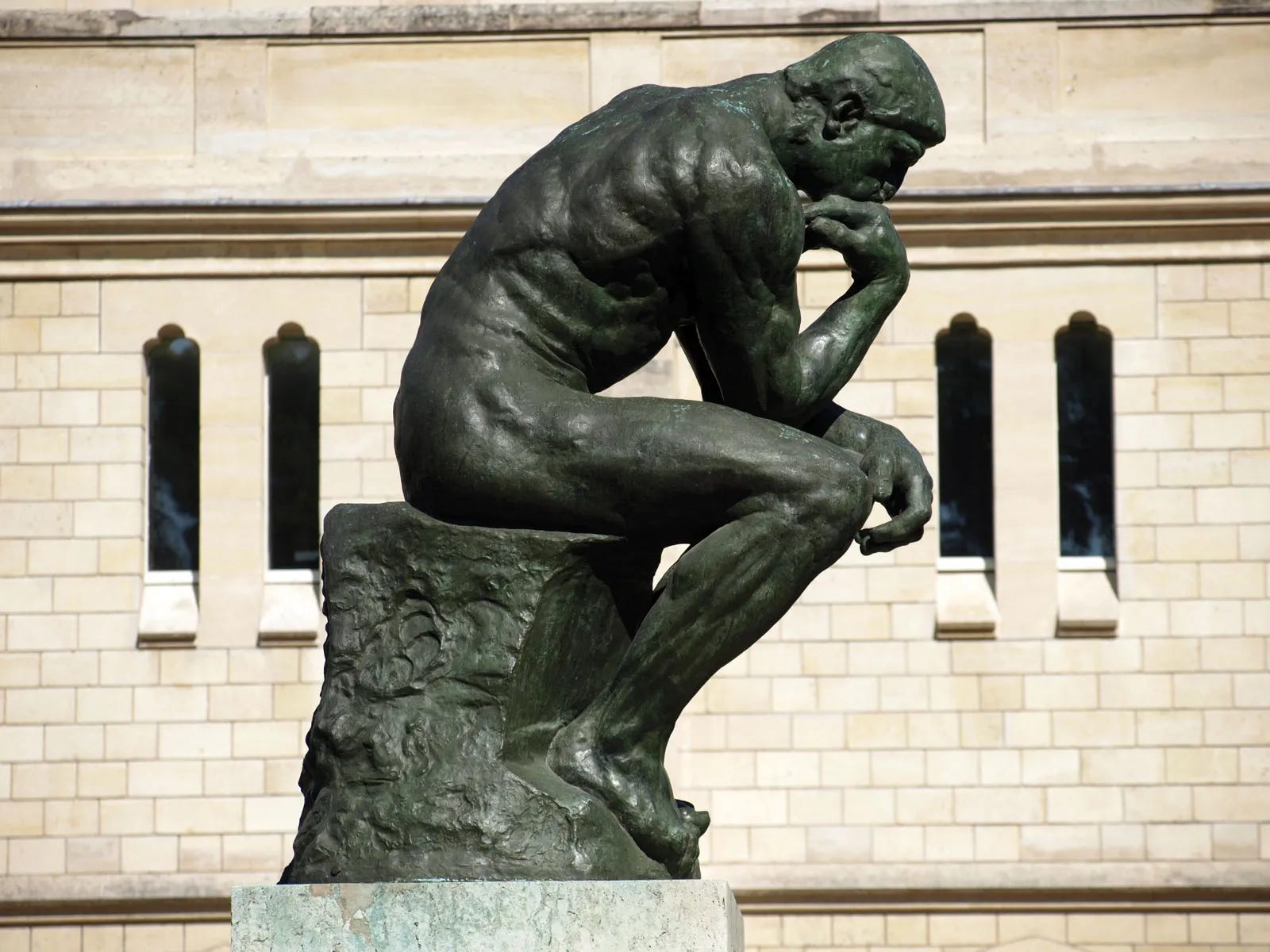
If we go by the book (specifically Merriam-Webster,) intelligence is defined as “the ability to learn or understand things or to deal with new or difficult situations.”
Snoozefest. Boring. Yawn.
It doesn’t really explain it, does it?
There are a couple of different approaches. Let’s talk about them.
Intelligence Quotient (IQ):
Everyone knows what an IQ score is. The average is 100. If you’re above 144, you are the second coming of Albert Einstein.
Alfred Binet and Theodore Simon pioneered the first practical intelligence test for school children. It tests memory, problem-solving, deductive reasoning, etc. It wasn’t until Stanford psychologist Lewis Terman revised it that we got the IQ, a single number that represented your score.
People put a lot of stock into this stuff. There’s whole societies dedicated to people with high IQ scores (mainly talking about Mensa, I’m sure there are others though.)
For funsies, here’s an example of a question on an IQ test. Answer is at the end of this article!
Now, if you suck at taking tests, then you’re just kinda screwed. Sorry.
IQ tests have had their validity questioned for a while now. It’s been used to make harmful generalizations about groups of people, claiming they have a “genetically inferior IQ.” Yikes.
Triarchic Theory:
Robert Sternberg was more progressive. He thought there were three kinds of intelligences, straying away from the IQ stuff and focusing more on real-world application.
He broke it up between analytical, creative and practical.
Analytical was about problem-solving, creative is about coming up with new and unique ideas, and practical is what we like to call “Street Smarts,” or knowing how to navigate all types of environments and applying your knowledge.
The Theory Of Multiple Intelligences:
This is the approach I agree with the most.
Howard Gardner is a Harvard psychologist who argued that IQ sucks ass, deeming it a one-size-fits-all for intelligence when that shouldn’t be the case. There are actually many different types of intelligence. He outlines them as such:
Bodily-kinesthetic intelligence: The ability to control body movements and handle objects skillfully.
Interpersonal intelligence: The capacity to detect and respond appropriately to the moods, motivations, and desires of others.
Intrapersonal intelligence: The capacity to be self-aware and in tune with inner feelings, values, beliefs, and thinking processes.
Logical-mathematical intelligence: The ability to think conceptually and abstractly, as well as discern logical or numerical patterns.
Musical intelligence: The ability to produce and appreciate rhythm, pitch, and timbre.
Naturalistic intelligence: The ability to recognize and categorize animals, plants, and other objects in nature.
Verbal-linguistic intelligence: Well-developed verbal skills and sensitivity to the sounds, meanings, and rhythms of words.
Visual-spatial intelligence: The capacity to think in images and visualize accurately and abstractly.
It’s like the quote. “Judge a fish by its ability to climb a tree and it’ll live the rest of its life thinking it’s stupid.”
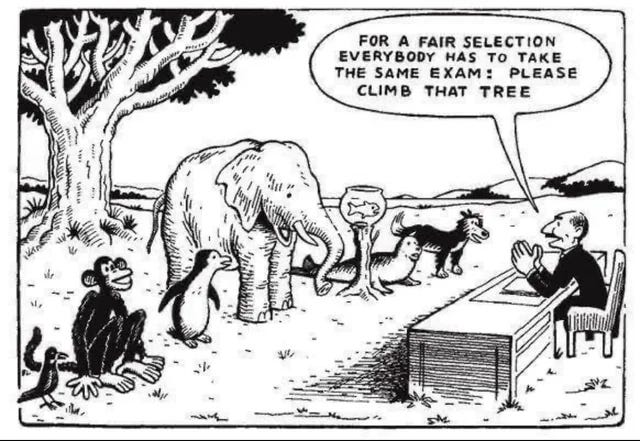
I think this one makes the most sense and is more all-encompassing than some of the other approaches, which to me feel a bit elitist.
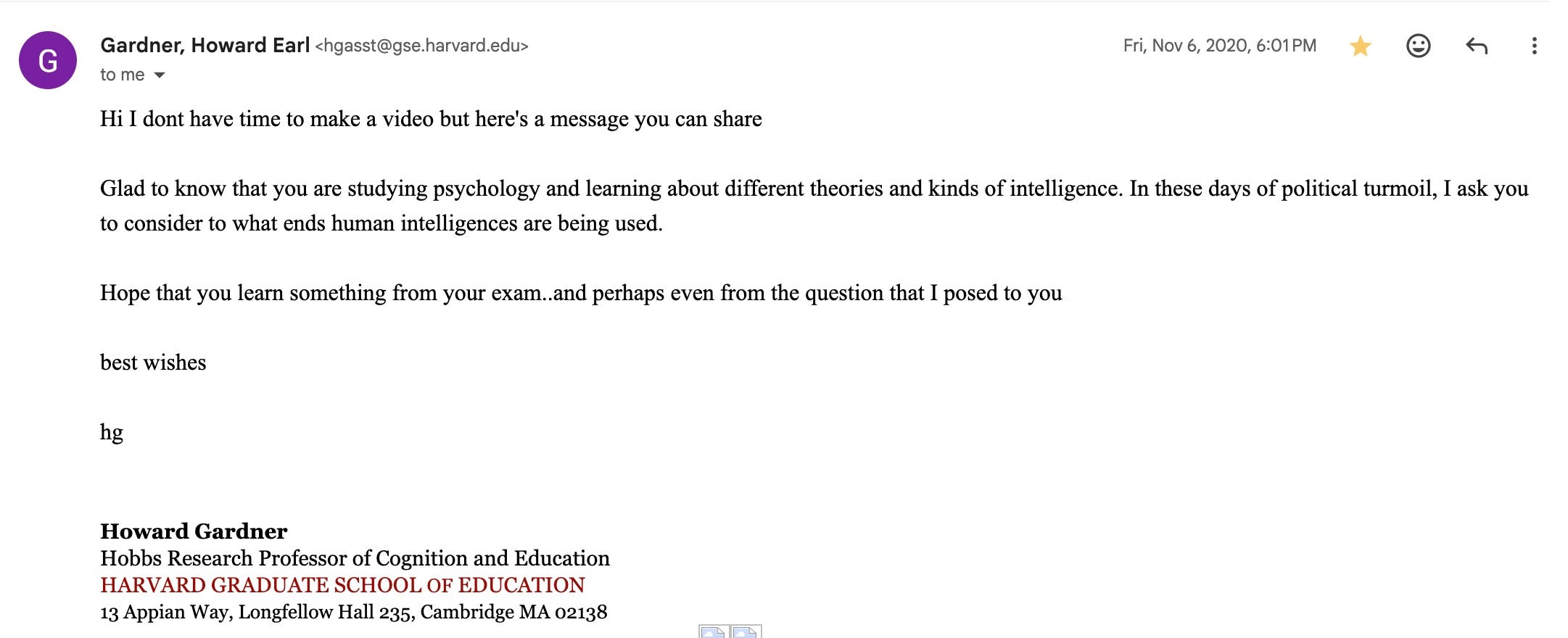
Fun fact: I was bored one day in high school and decided to see if Gardner was still alive. Whenever a textbook talks about someone, they are usually dead. I wanted to see if I can talk to someone who was not dead.
He was indeed alive and well. I asked if he could shoot a 10-second video for our AP Psych class, wishing us luck on our big exam. He responded.
What Do I Think Intelligence Is?
You care about what I think? Aww.
Well, if you ask me, I think an intelligent person is one who acknowledges and accepts that they cannot possibly know everything.
It’s not just humility, it’s the truth.
Learning is a lifelong journey. Someone who I find to be intelligent knows this. They have a voracious appetite for knowledge. They are curious about things, passionate about them. They apply themselves.
And this is the most important part.
If you ask them a question and they don’t know the answer, they won’t get embarrassed and make up some bullshit. They’ll try to find the answer with you.
That to me is the immediate sign of someone who actually wants to be intelligent instead of pretending to be for optics.
Conclusion:
Dear reader, I don’t think you’re stupid — even if you did click on this article.
I buy heavily into Howard Gardner’s approach — can you tell by the difference in length between their sections? I think everyone is intelligent in their own areas. That’s a beautiful thing.
If everyone I had to interact with was purely book smart, I think I’d kill myself.
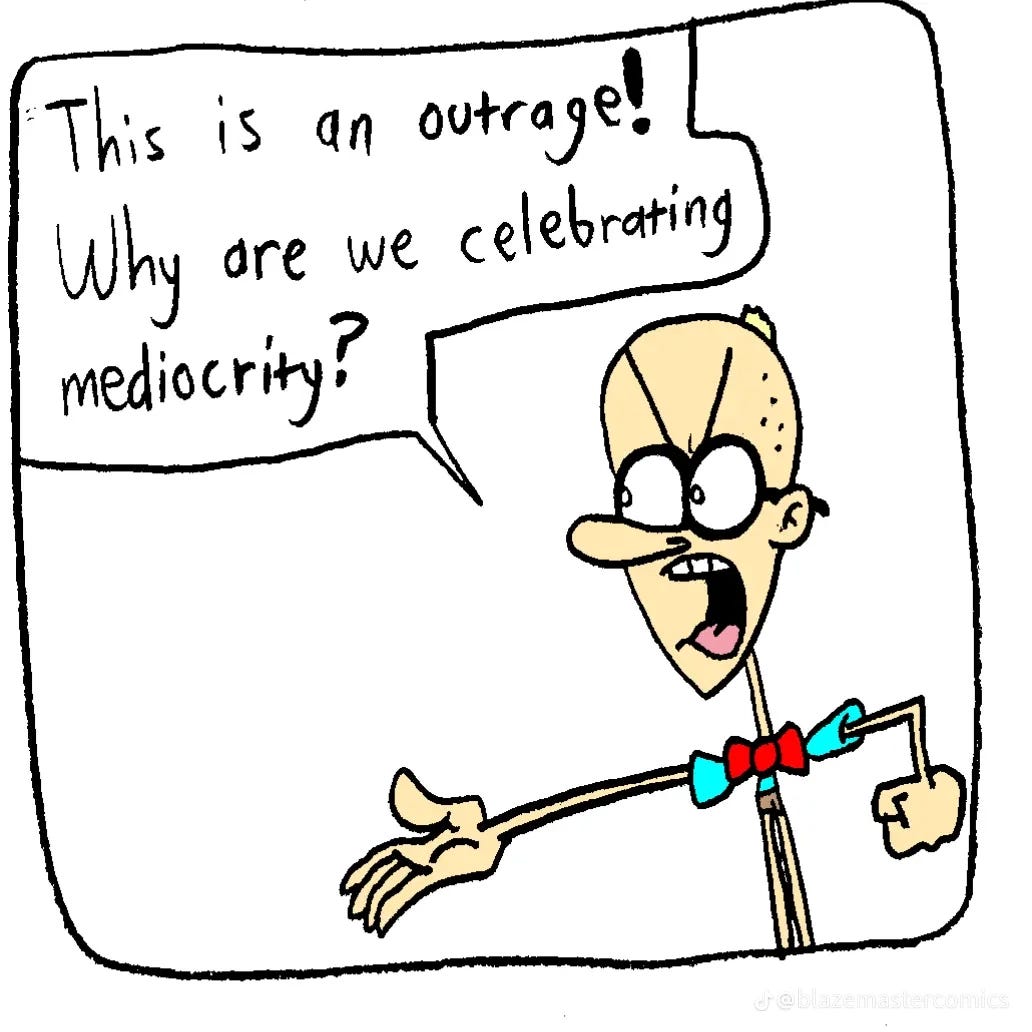
Thanks for reading, and don’t let me catch you clicking on articles like this one again.
Oh by the way, the answer for that IQ test question was island. Aren’t you glad you scrolled to the end? Don’t you feel smarter already?
you are my goat, this was a delightful read